

“Dairy issue still open” tells the next manager that something happened. It does not tell them what has already been done, who is responding, or what they need to check. A useful retail shift handoff closes that gap with a few concrete details.
The goal is continuity. The next leader should be able to identify their first action without calling you to reconstruct a conversation. That starts with recording status while the shift is happening, then reviewing what remains before you leave.
A late task and an unfinished task can both belong in a handoff. The useful question is not “What did I do today?” It is “What does the next leader need to know or follow up?”
Use five fields for each open item
You do not need a paragraph for every event. Start with five fields:
- Area: Where does the follow-up belong?
- Current status: What is known now?
- Action taken: What has already happened?
- Next owner and action: Who is checking what?
- Next review: When should that person look again?
Add the timestamp of the latest update when circumstances may change. If you do not know the owner or next review time, say so and agree it before leaving. An empty field can reveal an unresolved responsibility more clearly than a polished summary.
Write facts that another leader can act on
For a staffing change, capture the affected period and current coverage decision. A useful example is: “Bakery afternoon coverage arranged; closing manager to confirm the updated break plan at shift start.” Avoid unnecessary personal details about the colleague who is absent.
For a refrigeration follow-up, record the equipment or area reference, the approved escalation already made, and the response you are waiting for. For example: “Dairy service request logged in the company system; duty manager awaiting callback; incoming manager to check the ticket at the agreed review time.” Keep the official reference where the next manager can find it.
Equipment and food-safety decisions must follow your store's procedures and qualified guidance. A handoff note does not assess whether products or equipment are safe, and Taldi does not monitor refrigeration automatically. The note exists to preserve the follow-up after the immediate response.
Distinguish completed work from a waiting response
“Contacted supplier” is a completed action. “Repair complete” is a different status. Keep them separate. Otherwise the next leader may assume that making the call resolved the issue.
The same applies to district requests. “Labor report sent for review” does not mean “district manager approved.” Record the next expected step and who will check it. If no reply is required, close the item instead of carrying it through every handoff.
A useful review question is: could someone reasonably read this as more complete than it is? If so, rewrite the status plainly.
Start with a quick note, then choose the tasks
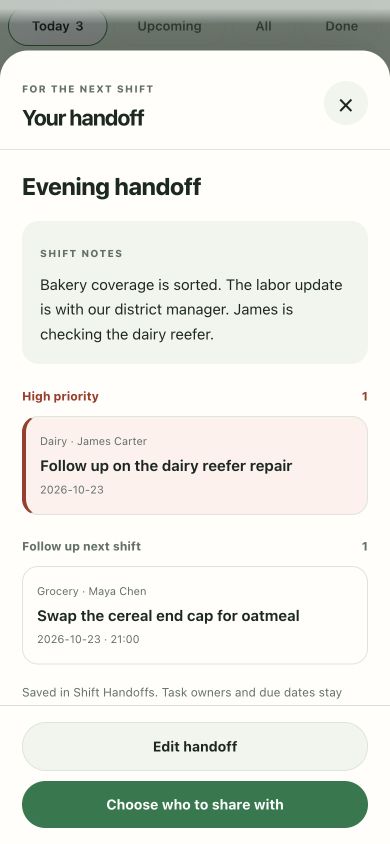
Give the next leader the shift in a few sentences: bakery coverage is sorted, the labor update is with the district manager, and James is checking the dairy reefer. That is the context.
Underneath, select the work that still needs a follow-up. Include tasks you gave to other departments earlier in the day, even if they are not due until after you leave.
For the evening shift
James is following up on the reefer repair. Check the latest callback status and agreed next action.
Have Grocery swap the cereal end cap for oatmeal at the end of the night. The three-day sale is over.
High priority should mean “start here,” not “everything feels busy.” Keep regular follow-ups visible without giving every item the same urgency. A short, chosen list is easier to use than every open task in the store.
Finish with a short verbal check where possible
A written handoff makes information available; a brief conversation can confirm responsibility. Walk through the few items that need a decision or timed follow-up. Ask the incoming leader to confirm which items they are taking and flag anything that remains unclear.
If shifts do not overlap, use your agreed communication channel and escalation process. Do not treat a saved personal note as proof that another person received or accepted the work. Likewise, marking a task complete should reflect the work itself, not just the end of your shift.
Keep a template small enough to maintain
Begin with open staffing, operational follow-ups and commitments to other leaders. Leave out a detailed diary of routine events unless it is useful for your operation. A short, maintained handoff is easier to use than an exhaustive account nobody has time to review.
In Taldi, use Build a handoff to add your shift note and choose unfinished tasks. Set each handoff item to High or Regular, then save it in Notes → Shift Handoffs. The task’s owner and due date stay unchanged. Review the saved handoff and choose linked teammates when you are ready to share.
Use shift-aware routines to make handoff preparation a repeatable part of your own shift. The best time to discover a missing next action is before the next manager needs it.